


Cairo – September 2026
Cairo International Film Festival announces the launch of the « From Book to Screen » forum for the first time this year, as part of Cairo Industry Days, scheduled to take place from November 11 to 20, 2026. This new initiative aims to rebuild the bridge between the publishing industry and the cinema and audiovisual content sector, opening broader horizons for adapting Egyptian and Arab literary intellectual property into screenworks.
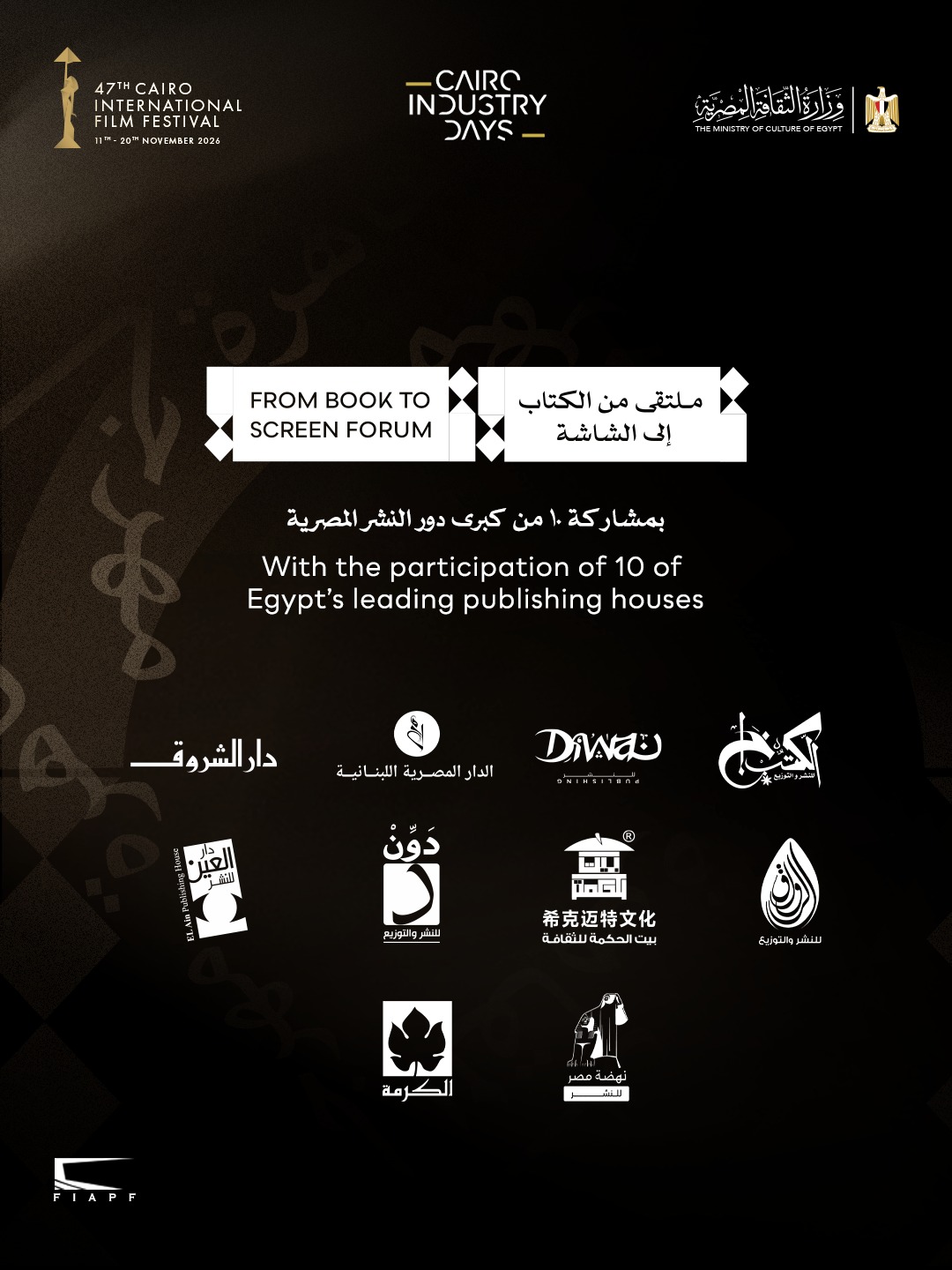
The inaugural edition of the forum features the participation of 10 major Egyptian publishing houses, namely (in alphabetical order): Al Ain, Al Karma, Al Masriah Al Lubnaniah, Al Rewaq, Bait El Hekma, Dawen, Diwan, Kotob Khan, Nahdet Misr, and Shorouk. This participation gains its significance from the established position of these houses, which publish the works of leading Egyptian writers and novelists, achieving tremendous success and widespread sales in the publishing market. These works possess strong dramatic elements and narrative structures that qualify them to transition this trusted massive success from the pages of books to the drama and film market, providing content that already enjoys a pre-existing readership base. This presence reflects the diversity characterizing the Egyptian publishing market and its wealth of literary works and intellectual property ripe for discovery and development in the audiovisual content sector.
*Hussein Fahmi: Literature has always been one of the most important tributaries of Egyptian cinema*
Regarding the forum, Hussein Fahmi, President of Cairo International Film Festival, stated: « Literature has always been one of the most important tributaries of Egyptian cinema, and many of the films that made cinema history were linked to literary works by prominent writers. It is important to rediscover this vast reservoir of novels, stories, and biographies that can provide cinema with new works, characters, and tales. »
He added: « The ‘From Book to Screen’ forum aligns with the interest of Cairo International Film Festival in developing the industry and creating new spaces for collaboration among its various elements. We hope it represents a practical step toward rebuilding the relationship between publishers and filmmakers, paving the way for more Egyptian and Arab literary works to reach the screen. »
This initiative stems from the deep historical relationship between literature and Egyptian cinema. Novels, short stories, and biographies have constituted one of the most important sources of cinematic creativity. The works of major Egyptian writers, including Naguib Mahfouz, Ihsan Abdel Quddous, Taha Hussein, and Tawfiq al-Hakim, contributed to producing a collection of prominent films that became milestones in the history of Egyptian and Arab cinema. This connection granted Egyptian cinema a rich repertoire of characters, tales, and literary worlds, contributing to the creation of works characterized by human depth, cultural diversity, and strong dramatic structure, ultimately becoming part of the Arab cinematic memory.
In recent decades, the relationship between the publishing and audiovisual production sectors has seen a noticeable decline, coinciding with shifts in the content industry and methods of developing film and television projects. At the same time, the Egyptian and Arab publishing markets continue to produce literary works, biographies, and human experiences with immense potential to be adapted into films and series, yet the opportunities for many of these works to reach the screen remain limited.
The forum aims to present literary intellectual property (IP) as a vital source for developing new audiovisual content, offering producers and content creators the opportunity to discover Egyptian and Arab literary works that possess the fundamentals for adaptation into films, series, and dramatic projects. Through this initiative, the festival also seeks to contribute to building a more organized market for adaptation rights and encourage professional partnerships between publishers and producers, preserving the rights of creators while paving the way for their works to reach a wider audience across various exhibition formats and platforms.
The launch of this forum marks a new step in the trajectory of Cairo Industry Days by expanding the circle of participants in the content industry. It opens a new space for publishers, authors, producers, and platforms to connect regarding the future of literary intellectual property and its potential for audiovisual adaptation. Cairo International Film Festival aspires for this initiative to evolve in upcoming editions into a leading regional platform for adaptation rights, contributing to the discovery of more Egyptian and Arab literary works and bringing them to cinema, television, and digital platforms, thereby reaffirming the creative relationship that has bound books to cinema throughout history.
*About Cairo International Film Festival*
Cairo International Film Festival was established in 1976 and is one of the most prestigious film festivals in the Arab world and Africa. It is the only Arab and African festival accredited as a Category « A » festival by the International Federation of Film Producers Associations (FIAPF). It is held annually under the auspices of the Egyptian Ministry of Culture. Throughout its history, the festival has solidified its position as a major platform for Egyptian, Arab, and international cinema, combining film screenings with cultural dialogue, supporting the development of the film industry, and discovering new talents and projects.
*About Cairo Industry Days*
Cairo Industry Days represents the professional platform of Cairo International Film Festival, aimed at supporting and developing the cinema industry in Egypt and the Arab world. It provides a space that brings together filmmakers, producers, distributors, and representatives of platforms and cinematic institutions, offering opportunities for networking, project development, expertise exchange, and partnership building. Cairo Industry Days has become an essential part of the festival’s vision to enhance its role in supporting the industry and opening new horizons for filmmakers in th region